Saturday, 6 August 2016
Interest Rates fall. What should Pension Funds do? NOTHING !!!
The Discount Rate is an assumption. Liabilities extend forward for decades (30/40 years) and nobody can forecast what level of interest rate will apply. It is reasonable to assume that at some point rates will revert to traditional norms. That is to say significantly higher than at present. So using current rates substantially overstates a fund's liabilities.
The prudent Fund Manager will not panic and certainly not seek sponsor support to boost assets to match liabilities which by any rational analysis are significantly overstated. Better to run for a time with a negative funding ratio than to send good money chasing after bad.
Tuesday, 25 August 2015
Pensions–the stock market crash is bad news for an unlucky few.
"Pensions hit as stock markets crash" is the usual tabloid headline and in the past it was never true. That was for three reasons. Firstly many of us had final salary "Defined Benefit" (DB) pension schemes which guaranteed our pension even if the asset levels of the funds fell because Equities had fallen in value - however dramatically. Second these DB schemes were invested in a variety of asset classes of which Equities were only one. Bonds, Gilts, Property etc. were not (directly anyway) affected when stock values fell. Third the law requires that when Assets in a scheme fell, and if they stayed below Liability projections for some time, then the "sponsor" of the Fund, usually the employer, must fund the shortfall with a cash injection. Despite the changes in the world of pensions all of the above remains true for all of us lucky enough to be in DB schemes - crucially that includes almost everyone working in the public sector where DB remains the norm. These are the "Haves".
So what about the "Have-nots"? Over the past twenty years or so most DB schemes have been closed to new entrants and even before that significant numbers of workers either had no pension or had only a "workplace savings" scheme of far lower real benefit than DB. These savings schemes were often dressed up by employers and the Financial Services sector as being “Pension” schemes (and called “Defined Contribution” (DC) Pensions) but in fact they were not. True on retirement the employee was required to purchase an annuity with the accumulated savings – and an annuity is a pension (of sorts!) by another name. But what DB gives in terms of predictable and often inflation-protected income in retirement is largely absent in a DC scheme. And the changes to the law in the 2014 Budget – the so-called “Pension Freedoms” - mean that a saver, if he or she chooses to, can take the money and run. There is no obligation to convert the built up “cash pot” into future income by buying an annuity.
Although we use the term “cash pot” the savings in DC schemes only actually become cash when the assets in which the pot has been built up are sold. And this is where falling stock markets are potentially very hazardous. DC scheme assets favour equities because over time such an investment provides higher returns than more secure but lower return asset classes like bonds and gilts. The key point here is “over time” – indeed the timeframe is absolutely crucial to DB schemes where short term falls in stock values are largely irrelevant because the timeframe over which the assets have to deliver returns is so long – thirty years or more. And over the decades, despite swings and roundabouts along the way, the stock market will provide a better outcome than the alternatives.However there is one exceptional risk for DC schemes which does not exist for DB. The value of a saver’s pot depends on the value of its underlying investment on the day that the employee becomes a pensioner. And that day is usually predetermined. So if the Stock Market has fallen 10% a few days earlier the employee’s pot will also have fallen - and the amount of his pension (if he buys an annuity) similarly.
The switch from DB to DC has taken the risk associated with pensions away from the employer and placed it on the employee. It has removed the guarantees inherent in a DB scheme - there is no expectation that a DC scheme will deliver a pension that relates in any way to the employee’s recent earnings. Nor that it will be inflation-proofed. Nor even that the actual value of a pension pot will not be subject to the vicissitudes of stock markets.
There have been some positive developments in pensions in recent times – not least “auto-enrolment” which brings many employees into workplace savings (for retirement) who were not there before. But the switch from DB to DC has been a social shift of a scale which has still not been fully understood. In the public sector, post Hutton, benefits have been somewhat reduced but an employee – including new employees – still has a DB scheme of which to be a member and benefits from it which far exceed the new DC norm in the private sector. Not least of these is the fact that the “shock horror” headlines really do not apply to DB schemes members at all. They may not apply to all DC schemes members either – but for those approaching retirement and the moment when they cash in their “Pot” it really can be very bad news indeed.
Monday, 11 August 2014
Michelle Cracknell – building TPAS into the UK’s main resource for Pensions guidance for employees and pensioners.
“We are” says Michelle Cracknell, the Chief Executive of The Pensions Advisory Service (TPAS), “for the first time in my lifetime, reaching a consistent approach to pensions in Britain”. Cracknell has been in her job a little under a year but she is clearly enthusiastic both about her role at present and especially about the possible opportunity for TPAS to deliver the guidance announced in March 2014 Budget. She also relishes the public service aspect of the job, which provides her and her staff with high levels of job satisfaction.
Early Days
Michelle Cracknell was born into a Royal Air Force family and like many Armed Forces children she was sent to Boarding School – Christ’s Hospital in her case a school where pupils’ fees are assessed according to family income which, she says, results in a social and cultural diversity that is unusual and very special. Cracknell thinks that this background not only set some important values in place but also gave her a “dogged determination” to succeed. After school, she went to Imperial College where she studied Civil Engineering but instead of pursuing an engineering career she decided to go into the Financial Services sector. She joined the independent advisory consultancy “Advisory and Brokerage Services Ltd (A&B)” which specialised in the high net worth private client sector - as well as having a substantial corporate client portfolio. Cracknell’s pensions involvement was both with individuals’ personal pensions and also with small corporate schemes. She recalls the first rumblings of corporate concern about the cost and obligations of Defined Benefit pension schemes surfacing at the time around 1990 when Government signalled an intention to require DB schemes to index-link pensions in payment. Many small schemes were closed by sponsors in response to this “threat” (a threat which became a reality in 1997).
Working for a “Provider”
When A&B was acquired by AEGON in 2002 Cracknell stayed and became part of this much larger company for whom she worked for five years. Then, in 2007, she moved away from pensions, temporarily as it turned out, when she joined Skandia (part of Old Mutual Wealth) as Director of Strategy – just in time for the Global Financial Crisis! It was Cracknell’s first experience of working for a “provider” and in challenging times. She readily accepted that she was not an expert in investment but says that “…you didn’t really need to be an investment expert to work on the company’s strategy”. She had responsibility for the company’s strategy for the post Retail Distribution Review landscape , which included the disposal of the non-core business Bankhall to Sesame as well as other restructuring projects.
Pensions Consulting
In 2010 Cracknell decided to leave Skandia and become a management consultant with Bluerock. She says that the ongoing trend towards the closure of DB schemes, the planned introduction of Auto-enrolment, the Government’s “Retail Distribution Review” affected firms across the value chain and presented opportunities for her to consult and advise. I asked whether she detected a declining enthusiasm on the part of employers to make pension arrangements for their staff. She said that there was some of this but that this was countered by the realisation that with age discrimination legislation coming into force unless employees felt confident about their personal financial circumstances on retirement they may well stay in their jobs – which was very often not the ideal outcome for the business!
The attractions of TPAS
In 2013 Cracknell was informally approached about the position of Chief Executive of TPAS. Initially unsure she took soundings and did research on an organisation about which, she admits, she previously knew little! The more she learned about TPAS the more she came to the view that it could offer her a big opportunity to work in an area where she could genuinely be a force for good. Above all, the independence of TPAS was the key and its mandate to serve the public, directly and professionally. Cracknell was not a “shoe-in” for the job which she had by now decided she really did want! Competitive interviews were held and there was a month of nail biting before she was advised that she had been appointed!
A Stimulating Work Environment
If altruism was the driver for Cracknell to become the boss of TPAS, the stimulating work environment was soon to confirm to her that she had made a good choice. There are twenty skilled people on the “Helpline” answering queries and helping callers on a wide diversity of pensions related matters. There is a huge volunteer back up with no fewer than 370 volunteers across the country (two thirds of whom are still in fulltime work as lawyers, actuaries etc.) TPAS is not a consumer body and has no conflicts of interest. So when there is a pensions dispute to be resolved (one of their key roles) they can and do offer genuinely independent advice. With a budget of around £3.8 million TPAS is a modest charge on the general Pensions Scheme levy. Following the 2014 Budget, the Service’s role may well expand.
Surviving the “War on Quangos”
For TPAS to be credible as a service at a time when there has been a “war on Quangos” they must not only offer timely and professional advice but do so in a cost effective and sympathetic way. With 80,000 cases dealt with last year (that’s about £40 a case) there is certainly value for money. And with all the front line staff trained in counselling skills (with help from The Samaritans) there is plenty of sensitivity as well. Immediately following the Chancellor’s recent Budget, the number of cases being handled every day by TPAS tripled – and this is almost certainly the precursor of a greatly expanded role for TPAS. In the Budget, the Chancellor announced that there would be “Guidance” provided to those retiring with Defined Contribution pots now that an Annuity purchase is not mandatory. The Treasury Select Committee followed this by saying that this guidance must be “demonstrably impartial” – which may preclude Financial Service providers from providing the guidance. This is a huge opportunity for TPAS who, along with the Money Advice Service (MAS) and the Citizens Advice Bureau, are in the prime position to be the approved providers of advice.
Expanding TPAS to provide Guidance for all
Michael Cracknell is enthusiastic about the joined-up approach to Pensions which has emerged in recent times – single tier State pension and private pension reform - and she sees Guidance as being a crucial addition to this coherent approach. She is confident that TPAS is the right body to provide a guidance service who TPAS will need at least to double its resources to meet the demand. Cracknell says “Savers must know all the options that could be right for them - and every case is subtly different. TPAS has the experience and the skill set to do this and its independence is well established.” The workplace savings waters are choppy at times and there are sharks around (the scams of “Pensions Liberation” are something that TPAS frequently warns callers about). One Pensions commentator called TPAS “Britain’s best kept financial secret” and that is something that Michelle Cracknell seeks to change. She wants TPAS to be better promoted and better known – the more guidance they are called upon to give, the better. It looks likely that with the Government’s commitment to Guidance this is sure to happen.
Paddy Briggs
This article first appeared in the July/August edition of “Pensions Age”
23rd June 2014
Monday, 7 July 2014
Union action may be counter-productive – especially over Public Sector pensions
The Tories, unsurprisingly, are using the upcoming Public Sector one day strike as a reason for a bit of Union bashing.
As a Director of a large private sector Pension Fund for four years and as a writer and commentator on Pensions matters I have thought a bit about the subject of the disparity in benefits between the two sectors. It isn't just pay (as Tim Montgomerie points out in the article in “The Times”) that favours the Public Sector, it's pensions as well. Most public sector employees are in Defined Benefit (DB) schemes which are still open to new recruits. In the Private Sector most of these schemes are closed to new entrants who are offered only the far inferior Defined Contribution (DC) scheme instead. (With the Budget changes the reality that such schemes are not proper Pension schemes anyway but workplace savings devoid of proper Pension guarantees was made crystal clear).
In future private sector employees, except for the fatter cats at the top, can expect to work longer and enjoy much lower retirement benefits than their opposite numbers in the public sector. This may skew some in the employment pool towards the public sector rather than the private - if the jobs are there. As most public sector schemes are unfunded this will continue to be a large part of Government spending. It is true that post Hutton public sector employees retirement benefit prospects are somewhat lower. But they are still far, far more generous than the private sector will offer.
We are, in the private sector, largely in a post Union world. Workers’ rights, including pay and pensions, have slipped so that there is less job security, lower (comparatively) pay, hugely reduced retirement benefits, longer working lives etc. The destruction of collective bargaining means that there are few if any, fora for negotiation and debate. Nobody protects workers interests any more. In the public sector this is not the case.
Tim Montgomerie and many others on the Right want the public sector to be more like the private sector - code for reducing Union power and allowing lower pay and lower benefits to be forced on the workforces. Although I do not believe that the Unions should be striking at this time - especially over pensions - I welcome their continued presence in the public sector world and greatly lament their disappearance from the private sector. It's back to the future when Victorian employment practices become the norm and there is nobody to stand up for the workers any more.
Thursday, 20 March 2014
Its a Pensions revolution in prospect

I doubt that any forecasters looking at what the 2014 Budget might have in store for us predicted the demise of “Defined Contribution (DC)” Pensions Schemes as we know them. But that is in effect what the Chancellor of the Exchequer announced yesterday. It will take a bit of time to get used to the new world and as the Chancellor hinted it might not just be DC scheme members who “benefit”:
“There will be consequential implications for defined benefit pensions upon which we will consult and proceed cautiously”
Let’s look at what this might mean in a moment. But first what about the saving for retirement revolution that will soon get underway – for that is what it is? I have always thought that to call a DC plan a “Pension Scheme” was a misnomer – the fiction was convenient to some, not least employers, who could claim that they were finessing their Pension offer by moving from Defined Benefit (DB) to Defined Contribution. In fact, of course, DC has never been a Pension Scheme at all but a savings scheme. The only thing that made it comparable with DB was that on retirement the member had to buy an Annuity with the pot of the scheme (or 75% of it anyway). In other words by contributing to a DC scheme you were buying yourself a Pension so in that sense it was indeed a Pension scheme. With one fell swoop the Chancellor has changed that. DC is now a savings scheme pure and simple. Of course as the Chancellor said:
“Those who still want the certainty of an annuity, as many will, will be able to shop around for the best deal.”
…but they don’t have to. If they want to take their pot as cash and spend it on a round the world cruise or two they can. In effect Osborne is throwing down a challenge to the Financial Services sector to invent products that might be so good that retirees won’t want to blow their pots in one go! And those products have to be a darn sight better than the current Annuity based deals don't they? An average DC pot of £25,000 gives you an annual annuity-based income of around £1400 at 65. You'd surely “take the money” if that was the best you could get wouldn't you?
So what about DB schemes and was the Chancellor really hinting that he might apply the same principle to these? Well the ideological driver must be the same. This is what he said about that:
“People who have worked hard and saved hard all their lives, and done the right thing, should be trusted with their own finances”
So if this is you and you happen to be in a DB scheme what is the value of your “pot” if you retire at 65 and will receive a Pension of say £15,000 (the average pension in many major private sector UK schemes). Well based on current Annuity rates that value is around £300,000. So if we apply the new DC rules to this the retiree could walk away with a sum not unadjacent to this to do with what he will. Attractive for many I would think. If this happened the Liabilities of the DB scheme would reduce coincidentally with the retiree deciding he will have jam today rather than Jam tomorrow. If the majority of retirees took the cash option then there would be major implications for DB schemes of course. Assets would reduce annually by the total amount of pots cashed in, but Liabilities would reduce as well. It will need an actuary to work it out (as always!) but I would guess that the funding ratio would be unaffected, though the fund’s cash flow would be heavily negative of course. In the extreme variant of this you could even offer those of us actually drawing pensions the chance to convert our remaining future Pension entitlement to cash at any time. Sponsors with healthy mature schemes might actually like this a lot – it's the ultimate de-risking!
So given the Chancellor’s declared predilection for “trusting people with their own finances” why didn't he do this? My guess is that the public sector pensions burden makes it impossible – at least for the foreseeable future. Public sector schemes are DB - but most of them differ from private sector schemes because they are unfunded. So there are no Assets out of which to pay the cash pots – the money would have to come from the Treasury! And given the continuing size of the budget deficit no sane Chancellor would want to increase public expenditure if he didn't have to.
So there we are. A Pensions revolution no less with maybe more to come. A challenge ahead for everyone in the Pensions world. Interesting times!
Sunday, 9 June 2013
Proper Pension provision a casualty of an illiberal age
It gets insufficient media attention but to me one of the worst developments of the illiberal imperative Will Hutton writes about here in the Guardian is in regard to Pensions. As recently as ten to fifteen years ago final salary pensions were the norm in both the Public and the Private sector. Now the value of Public sector pensions has been eroded and decent Private sector pensions have vanished. Defined Benefit pension schemes offered comfort in retirement. Their replacement the Defined Contribution schemes are pathetic substitutes that offer little - certainly not enough to live on unless you are a very high earner. This switch did not happen because of Government action but because of inaction. Labour did not have it in its 1997 election manifesto. But they presided over this fundamental change to citizen rights (especially from 2003 to 2010) and must be roundly criticised for allowing it to happen. The companies couldn't believe their luck in being able to stop providing proper workplace pensions to their staff !
Monday, 29 October 2012
Let’s find a real Pensions cause for Boris to defend
by
Paddy Briggs
(From “Pensions Age” Magazine October 2012)
Boris Johnson, the Mayor of London, likes to see himself as a white knight leaping, as he puts it, “… to the defence of unfashionable causes” and in a recent article in The Daily Telegraph the cause he espouses is that of the Energy multinational BP. The corporation has apparently been threatened by a federal court in the United States with, in Boris’s words, “…and absolute crippler of a fine [which] some people say …will be in the region of $40bn”. Whether this is remotely likely I have no idea – it would be a sum that is nearly a third of BP’s market capitalisation of $135bn and would bring the very future of the company, at least in its current form, into doubt. Boris Johnson worries about this – and he is right to do so not least (in my view) because of the potential consequences for the members of the various BP Pensions Funds. But where I take issue with the Mayor is his statement that he needs “to speak up for everyone whose pension depends on BP shares” because “A lot of our pension funds have traditionally invested in BP shares, and if BP shares go down then that is bad news for UK pensioners…”
If a company the size of BP gets into serious trouble it is not good news for anybody but Boris is being alarmist and quite wrong to be so specific about the effect on UK pensioners. I am told that at the time of the Deepwater Horizon disaster in March 2010, when the company’s market cap. was around $180bn some $30bn of this was held by UK pension funds. In aggregate this is a huge sum and, in aggregate, if the unit share price falls this total value falls substantially as well - this is probably what Boris was referring to. But the reality is that it is doubtful if any single UK pension fund suffered materially as a result of this share price fall nor that any Fund would suffer if such a fall, or worse, happened again. A prudent investment policy, which all UK Pension Funds are statutorily required to follow, would preclude any fund having more than a fairly small percentage of its investments in any one Equity. In the case of the Fund of which I am a Trustee, for example, no single Equity represented more than 0.4% of our total investment at the end of 2011 ( although in theory we could have a higher percentage in one Equity if we chose to do so). It is also the case that a significant proportion of the Equity investments for many Funds is in vehicles which track indices like the FTSE and that if BP, or any other member of the FTSE, suffers a fall that is greater than the FTSE as a whole then the Fund’s holding in BP would decline anyway. There is a sort of self-correcting mechanism here which automatically favours investments in the more successful equities.
So if no individual pension fund has suffered significantly in the past, or will suffer in the future, from the collapse of the share price of one Equity like BP this, of course, means that contrary to what Boris Johnson is saying it is not “Bad news for UK pensioners” at all. As I mentioned, the real potential casualties from BP’s difficulties are BP pensioners and I am sure that the Trustees of the BP funds will be paying close attention to their sponsor’s covenant in these difficult times. But the BP fund is in the Top 10 of UK Defined Benefit scheme in respect of Assets Under Management and has, given the difficult economic times, a satisfactory funding ratio. I am sure that the BP Fund Trustees are not being complacent but it seems to me that it would only be in the case of a successful predatory takeover of BP that the status of the Pension Fund would be brought into question. And if that had been going to happen surely it would have been in the first half of 2010 when the value of the company halved in a few weeks following Deepwater Horizon?
To return to the Mayor of London and his defence of unfashionable causes. The cause that I would like to see him and other politicians pick up is that of our private sector retirees of twenty, thirty and forty years’ time. Public sector employees have, whatever they might think or say, been offered a Pensions deal which though not as good as in the past will still, in the main, give them a secure retirement. All too many private sector employees, however, have been offered no deal at all. If ever there was a ticking time bomb – and genuinely “bad news” for (future) UK pensioners - it is this. This is a real cause to “unsheath your columnar Excalibur” for Boris!
Paddy Briggs is a Member Nominated Trustee of the Shell Contributory Pension Fund. He writes in a personal capacity.
Paddy Briggs
Wednesday, 22 August 2012
The retreat from offering new employees a defined benefit pension in the private sector is now almost complete
The headline in the Financial Times was quite unequivocal: ‘Shell ends an era with pensions retreat’ and as a trustee of the Shell Contributory Pension Fund this and other similar press reports generated a fair amount of traffic towards me. This came from pensioners who wanted to know how they were affected and, especially, from many in the pensions world who wanted to know how I felt about it. It
was in answering a question from one pensioner friend that I realised the full extent of the misconceptions that exist about the role of the trustee. Many fund members, and quite a few others, do not realise that a trustee’s duty is only to represent the interests of the existing members of the fund and that we therefore have no role in respect of Shell’s remuneration and benefits policies for its new employees. I was able to reassure those fund members that contacted me that Shell’s proposed closure of their main UK DB schemes to new entrants (subject to the consultation process that is currently underway) does indeed not impact at all on the existing members of the fund. I was also able to reassure colleagues and friends that, in my opinion, Shell’s sponsor commitment to these DB schemes is unwavering.
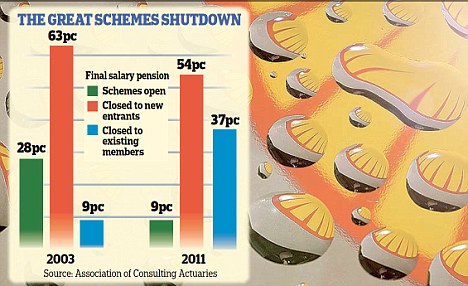
Shell’s expected decision is illustrative of the changes that have taken place in the world of workplace pensions in recent times. The origin of defined benefit pension schemes in the UK in the post-war years was a key part of the offer made to attract employees but also a feature of the more paternalistic culture of the times. In recent years, however, the private sector schemes have suffered what the Association of Consulting Actuaries (ACA) has called a “seismic collapse”. At some point over the past 10 years or so the norm switched from one under which the promise of a final salary pension on recruitment was standard to one under which only a defined contribution pension was offered. And once that switch had happened there was no turning back.
In its announcement Shell said that it reviews retirement benefits “to ensure that they are competitive in the local market and meet business needs” and that the DC scheme it will offer in future will offer “a strongly competitive retirement benefit so that Shell can continue to attract and retain the talent we need”. I have no doubt that this will be the case. But the key point from an employee perspective is that in normal circumstances DC schemes can never match DB schemes in what they deliver unless the levels of contribution made are at improbably high levels. True, the more you put in the more you get out but for all but the very highest paid employees it is unrealistic to expect that a DC scheme will deliver the same retirement benefits as a DB scheme. In the far from atypical Shell case most new employees joining in 2013 and retiring in say 2048 are unlikely to enjoy anything like the pension in retirement that the employee who joined in 1978 and retires in 2013 will benefit from. Next year’s retiree will get 1/54th of his final salary for each year of service - this was the accrual rate when he joined. So if he had a salary at the national average of £26,000 on retirement his 35 years’ service will deliver him a pension of around £16,000 – roughly 65 per cent of his final earnings. To achieve a similar pension from a DC scheme that employee would have to have built up a pot of around £400,000 at current annuity rates. In 2011 money, and assuming that the employee had worked for 35 years at £26,000 per annum, he would have earned a total of £910,000 over his employment years. That means that to have enough money in his pot he would have needed to build up an amount equivalent to around 45 per cent of his aggregate pre-tax income - every year he and his employer would have had to make contributions of £11,500 per annum to fund a pot sufficiently large to allow him to retire on a pension of 65 per cent of his final salary! The ACA estimates that at present average employer contributions to DC schemes are around six per cent with employees contributing on average four per cent - a total of 10 per cent compared with the 45 per cent necessary to equal the DB benefit. You can do the maths.
The background to Shell’s decision is not, as it may have been for some other employers who have done the same, because of any current problems with its UK pension fund. Indeed only four and a half years ago Shell halted payments into the fund and took a contributions holiday because it was so heavily in surplus at that time. (This, incidentally, gives a lie to the myth that the abolition of advance corporation tax relief, which removed tax relief on share dividends, and was introduced in the first Labour Government budget of 1997, was fatally damaging to the pensions industry as a whole. Well-managed schemes, such as the Shell fund, weathered that storm pretty well.) And presently, despite the turmoil in financial markets which has affected assets adversely and the falling bond yields that have increased liabilities, the Shell’s UK fund has a technical provisions funding ratio roughly in balance. If it chose to, Shell could probably afford to continue to offer a DB scheme to new entrants but the reality is that Shell judges that this is no longer necessary. What they have done is no more than virtually every other major UK employer has done as the FT and other media fairly pointed out.
Will Shell, and all the other private sector employers who have closed their DB schemes, come to regret it? in one area I think that they may. Obviously not offering a DB scheme to new entrants means that contributions, which are currently for Shell’s UK fund at a historic high of 31 per cent of salary (the contributions holiday is long gone) this to service the accrual of existing employee members will not have to be made for these new employees. The employer contributions made to the new DC scheme are likely to be much lower. However, when the current impasse over public sector pensions is finally resolved it is certain that the public sector will continue to offer generous retirement benefits - albeit somewhat less generous than is currently the case. A DB pension in the public sector based on career average salary will surely turn out over time to be beneficial compared with any employer’s DC offer. If you had a child or a grandchild considering career options and you compared for them the certainty of a public sector pension with the lottery of a DC pension I suspect that quite a few might turn their backs on the private sector and opt for the comparatively pension rich civil service instead.
We find ourselves in a world of unparalleled uncertainty – a world in which all too many of the old assumptions no longer apply. We cannot guarantee growth or employment or probably anything like the welfare benefits that we have enjoyed for more than 60 years – and as our economic systems struggle to adapt to the new realities, as individuals we struggle as well. One thing is, however, abundantly clear. The old paradigm of cradle to grave care, be it from the state or (partly) from an employer, is disappearing. An unintended consequence of these changes and of the growing disparity in retirement benefits between the private and public sector may mean that the pension cost advantages of privatisation as opposed to public sector provision could tip the case over in the direction of private enterprise. In the past companies ‘contracted out’ to save money and hassle so that they could concentrate their efforts on the added value rather than the cost side of the P&L. To offload any concern for future pensions liability from an internal DB scheme into a third-party provided DC scheme can be seen as more of the same. Whether there is intent on the part of government to encourage transfer of activities and personnel from the public to the private sector I don’t know. But there may be a paradoxical side-effect of making public sector pension benefits more attractive than those in the private sector. That is that some current public activities may become privatised simply because the long-term employment costs are lower in the private sector because of its lower pension cost loading!
Paddy Briggs is a Member Nominated Trustee Director of the Shell Contributory Pension Fund. He writes in a personal capacity and the views he expresses are his own
Monday, 19 March 2012
The Government’s raid on the Royal Mail Pension Fund
I am surprised that the Pensions world has so far been so sanguine about the extraordinary and unprecedented proposal by Government to sequester the Assets of
the Royal Mail Pension Fund. The action is almost Maxwellian in its audacity and whilst presented as being in the interests of the members of the Fund it is in fact a cynical move designed to boost the Treasury coffers and prepare the Royal Mail for privatisation. Whilst the Fund has a negative Funding ratio it nevertheless has £28bn of Assets that employees, the sponsor and trustees have built up over the years. It is the members’ money and only they have a right to it.
By transferring members from a funded trust into the much less assured world of being an unfunded liability on the public finances is far from necessarily in their interests. As we have seen Governments can and do change the basis of Public Sector pensions at their discretion and there is little that anyone can do to stop them. A Pensions Trust provides legal protection to its members and has Trustees to exercise that protective role. At a stroke Royal Main fund members will lose that security and no longer have Trustees acting in their interests.
Monday, 27 February 2012
The Trustee and the Investment Adviser
Every Investment adviser, whether it be to individuals, Pensions Funds or other institutions, preaches the mantra that diversification is a good thing - don’t put all your investment eggs in one basket. The cynic might say that by arguing for spreading the risk the adviser is coveri
ng himself – especially if there is a counterbalancing component to the asset classes he recommends! As a Trustee I am expected to exercise due diligence in my legal responsibility of overseeing the appropriate investment of the Fund’s assets. This includes ensuring that there is an appropriate spread of risk so that the Fund is as protected, as much as possible, from the vicissitudes of today’s pyretic world.
However unlike most other investments where bigger is always better a Defined Benefit Pension Fund has no underlying imperative to grow - and its legal construct is also very different from that of a PLC or a Limited Company. For me and I suspect many other Trustees with a past or present business career an early lesson that needs to be learned is that we are not actually running a business at all. True there are superficial similarities to, say, the operation of a company offering investment products to consumers. But the core objective of a Pension Fund is different, which brings us back to diversification.
As an individual or a corporate investor I probably want to grow my assets and at the same time protect them. “How much risk do you want to take” is the often asked but always unanswerable question that advisers love to pose. It is unanswerable because risk is an abstract concept - until after the event that is! If the advice leads to my becoming much richer then, with hindsight of course, it was good advice – even if along the way the risks were large. If the advice leads to the diminution of my net worth then it was bad advice, even though the recommended portfolio was seemingly wise, diversified and comparatively risk free.
In normal times (remember them?) we minimise risk by being diversified and for a Pension Fund that usually means achieving a suitable balance between Liability hedging and Return-seeking assets. But what is a suitable balance – conventionally that is determined largely by the Funding ratio.
If a schemes Funding Ratio is strongly positive – say in excess of 125% - today’s imperative for many funds is likely to be to “derisk” – that is to say to switch substantially, possible even completely, from return seeking Assets into those that hedge against future Liabilities. In a way this is a bit counter-intuitive. If your Asset management policy has successfully got you into a healthy position then why not do more of the same?
The answer, of course, comes from the fact that a Pension Fund’s objective is not to make as much money as possible but to make sufficient to meet its liabilities – with some margin for error. It is arguable that mature funds which are closed to new entrants should do this as soon as they can. The fact that the Fund is closed means that no provision for new employees needs to be taken account of in the Liability calculation – this estimate can be predicated completely on the present and future demands placed on it by existing members.
But what if a Fund’s Funding Ratio is negative and the sponsor cannot or will not make up the shortfall sufficiently to allow a switch to Liability hedging investments? Here the conventional wisdom is that far more of the Fund’s assets should be placed in return seeking assets like Equities. For me there is a feel of the Roulette table about this! Presumably the main reason that a fund has got in trouble is because it has been too heavily committed to highly volatile stocks and shares rather than largely risk free Bonds and Gilts.
Is more of the same the correct medicine in these circumstances on the grounds that it must all come right eventually? I’m not so sure that it is.
One option might be to try and come up with an income generating investment portfolio which gives sufficient inward cash flows to cover annual pension payment obligations and not worry over much in the short and medium term about the value growth performance of the asset itself. Better a stable blue chip with good dividends than one that might (or might not) grow ahead of the market. It would be these challenges I would be throwing at my investment advisers at the moment.
Paddy Briggs is a Member Nominated Trustee of the Shell Contributory Pension Fund. He writes in a personal capacity.
Paddy Briggs
“Pensions Age” January 2012
Tuesday, 20 December 2011
The Trustee and the difficult struggle for “Fairness”
From “Pensions Age” December 2011
It’s not just that the world of Pensions is complex or that, in some cases, the Pension Scheme is a huge burden on the funding Sponsor that being a Trustee is so challenging. Every Trustee also knows that it is an insufficient discharge of their duties just to ask the lawyers what to do when a decision on something important is needed. The challenge is at it
s most difficult when the law is ambivalent and we are asked to exercise judgment – simply put to decide what is “fair” in any one situation. It would be nice to be able to echo Abraham Lincoln and say that our members ask for one thing “fairness and fairness only” and that “…so far as it is in my power [this is what] they shall have”. The problem, of course, is what is seemingly fair to one person may not be to another - one group of Pension Fund beneficiaries may be advantaged by a decision but another group may be disadvantaged.
As a Trustee I must act in the best interests of the members and of the beneficiaries overall – and that latter category includes the Sponsor. It is arguable, and has indeed often been argued, that if a Company’s future prospects are seriously hampered by a burdensome Pension Fund then the Trustee should be sympathetic to change – even if that change is in some way disadvantageous to members. This in essence is the Government’s public sector proposition – that unfunded Public Sector schemes are too great a charge on taxation and that the package of benefits currently enjoyed by scheme members must be reduced. Whether you believe that to be “fair” or not depends partly on how you balance employee and pensioner rights on the one hand and the rights of the population at large on the other. No easy task!
Fairness is also linked to “norms”. If the majority enjoy a benefit but a minority, through no fault of their own, do not that is on the face of it unfair. Similarly if a privileged minority receive Pension protection when the rest of the members do not the charge of unfairness and discrimination can also be levelled. This brings us into the whole fractious debate about executive compensation and in particular about the “one per-cent” and the “ninety-nine per-cent”. The huge and growing inequalities that exist between the compensation of a small number of very senior executives in a company and the rest of that company’s employees carry on into retirement. The one per-cent will nearly always be protected from negative changes that might be agreed to the Pensions of the ninety-nine per-cent not just by the sheer size of their pension but by a willingness of their successor directors to ring-fence their predecessors’ substantial retirement income. It is, after all, in the interest of the existing Company Board to do this – they’ll be retired one day soon as well!
So when a Trustee is informed of a proposal for a change that he knows is solely designed to protect the interests of the already very well provided for 1% what should he do? Especially if, as is likely to be the case, the implementation of this change is external to the Fund and is neutral on it. There is no obligation on a Trustee to ensure that all members of a DB scheme are treated equally – it there was the increasingly common practice of closure of the Fund to further accrual would not be permissible. Similarly, and for the reasons already alluded to, there is no imperative of “fairness” – other than, perhaps, the highly subjective one of “Natural Justice”. We may, as individuals, regret that we have a society in which a small number of “High Net Worth” individuals just get richer but, as the music hall song has it, "It's the same the whole world over, It's the poor what gets the blame, It's the rich what gets the pleasure, Isn't it a blooming shame?". Having said that whilst it is rarely, if ever, the case that you make the poor richer by making the rich poorer the ratcheting up or protection of benefits for the 1% does, if it happens, somewhat alter the context within which the benefits of the 99% are being discussed. Class war rhetoric is probably best avoided – but the odd subtle hint that some members are more equal than others might help sometimes!
Paddy Briggs
Paddy Briggs is a Member Nominated Trustee of the Shell Contributory Pension Fund. He writes in a personal capacity.
Wednesday, 30 November 2011
Pensions – the increasing gap between the Public and the Private sectors
One of the least edifying aspects of the febrile debate on public sector pensions is the charge being made, often by people who should know better, that current public sector pensions are in some way “Gold-plated”. It is certainly true that the retirement prospects of employees in the private sector have been dealt a series of blows over the past decade – blows from which employees in the public sector have hitherto been immune. But it is facile and wrong to say that the problem is one of equity and that public sector pensioners should “suffer” in the same way that those in the private sector will.
Defined Benefit schemes
The basic premise of the pensions offer to employees in the past was broadly the same in the public and the private sectors – although whereas all public sector employees benefited far from all private sector employees had workplace schemes. The Defined Benefit (DB) pension schemes that were constructed in the immediate post-war years had two elements at their core. Firstly there was the understanding that the longer you worked for a particular employer the more pensions rights would accrue. Second there was the guarantee that when you retired your pensions would be directly related to your income at the time of your retirement. These DB schemes were predicated on the “Final Salary” principle. Typically a scheme would offer (say) 1/54th of the final salary for each year of service – so If an employee had a salary of £26,000 on retirement and had 35 years’ service his pension would be around £16,000 – roughly 65% of his final earnings. In addition, but not in all cases, he would be entitled to a State pension at 65 and this combination of “workplace” and State pensions offered the prospect of a comfortable retirement.
Lord Hutton’s Commission recommendations broadly retained the key elements of the DB scheme that public sector employees have traditionally benefited from. Crucially the DB principle itself is retained albeit that pensions will in future be based not on final salary but on a career average. However although the DB principle is retained, and there are other protections built in, public sector employees will have to work longer before they can enjoy a full pension and the annual increases to their pensions that they will enjoy in retirement will be linked to a lower index (the Consumer Price Index - CPI) than the Retail Price Index (RPI) that was used in the past. They will also have to pay more towards their pensions in “contributions” over their years of employment.
Public Sector Pensions are unfunded
The absolutely crucial point about pension schemes in the Public sector is that they are mostly “unfunded” and this fact lies at the heart of the Government (and Lord Hutton’s) proposals. Unlike schemes in the private sector there is no “pot” from which the pensions of a retired nurse or teacher will be paid. The “contributions” are not set aside but just go into the Treasury along with taxes - in effect contributions are just another part of the tax on incomes, like National Insurance. And the pensions payments are and will continue to be made from taxation. If this is understood the true driver of the Government’s actions becomes clear. it is promoted as a significant element of the deficit reduction programme - the Government wishes to reduce its expenditure and pension payments are in the firing line. The size of the public sector pensions deficit is enormous – between £780bn and £1200bn depending on which accounting convention you choose. In truth the changes proposed will have only a minor effect in the short-term and, like so much of the Government’s “Cuts” programmes, they can be seen as being more about maintaining economic confidence and protecting the UK’s AAA rating than anything else!
The strike is an action against spending cuts
The strike which took place on 30th November by public sector employees needs to be seen primarily as a strike against Government budget cuts. Arguably the most insidious element of what the Government proposes to do to public sector pensions is to change the annual increment indexation (from RPI to CPI) because this affects directly the income of today’s pensioners. In effect this is a retrospectively applied income tax. Pensions are deferred earnings – during years of employment workers accrue rights and make contributions and thus they defer some of their income until later (pension) years. To change this after employment is finished is a highly questionable action - almost a breach of contract (the social contract if not the legal one).
Pensions are deferred income
The comparison that should be made when the public sector debate is underway is not the comparison with the private sector but a comparison with other elements of public expenditure. If we look at a public sector employee from the date of their commencement of employment to the date of their death the Government pays them for their services over this full period. Some of the income is paid during the employment years and some is deferred until retirement – but it is all a payment made for a service rendered. Arguably the Government should no more change a pensioner’s rights than they should ask that same pensioner to return some of the salary they have already received! And certainly the “in service” change to an employee’s contract implicit in the Government proposals is a clear breach of the social contract that existed when that employee was originally recruited and throughout their employment to date. Pensions promises once made will not now be fully honoured because the changes proposed are not just to the deal for new employees but to the entire existing public sector workforce as well.
Private sector employees are increasingly vulnerable
If public sector pensions are a burden on the taxpayer (they are) the same does not apply to private sector pensions. And if some people decided to work in a career in the public sector because they felt that their financial future would be more protected then in the private sector they were certainly right to do so – at least so far as pensions are concerned. As we have seen the basic pensions premise in the past was broadly the same in the public and private sectors – even if the funding arrangements were different. In the private sector DB pension schemes have always been “funded” – that is a “pot” is built up by levying a contribution from employee and employer over the years of employment. For some well-managed schemes the pot is today broadly large enough to cover the likely future call on it. The Assets of the Fund match its Liabilities. However partly as a result of mismanagement and partly as a result of changing demographics (particularly significantly increased longevity expectations) many funds have a shortfall – a situation that is exacerbated by a difficult investment and economic climate. Over the last decade the mismatch between Assets and Liabilities has led many employers to make changes to their Pensions arrangements - changes that impact far more negatively on their employees than anything that the Government proposes in the public sector.
Companies are walking away from their Pension obligations
Publicly traded corporations are not charities and however much they might like to argue otherwise their principal and overriding obligation is to their shareholders. It was ever thus. As we have seen, in the past a company would offer its employees a compensation package which included Final Salary pension arrangements. They did this not because they felt any social obligation to look after their employees in retirement but because it was a pragmatic thing to do. If your competitors are offering a Defined Benefit pension scheme you better do so as well – in order to attract and retain staff. This was, of course, at a cost (the employer’s Pension Fund contributions) but it provided ancillary benefits in terms of loyalty and maybe also the opportunity to do a bit of bragging about being a socially responsible employer. This paradigm was largely unchallenged for over 40 post-war years.
But in the 1990s things began to change. The compensation culture, especially at the top of companies, moved from any element of “jam tomorrow” to a mainly “jam today” mind-set. Post Margaret Thatcher’s “big bang” the earnings potential in the City spiralled upwards and the bonus culture was born. Little of this trickled down to ordinary employees but it certainly trickled sideways moving from the financial sector to most other British businesses. As the head honchoes of British companies (especially the FTSE 100 ones) paid themselves more and more so they sought to find specious justifications for this largesse to themselves. This was to come from performance metrics which showed how “well” they were doing and why it was legitimate to pay themselves as much as they wanted to. Business is simple really. You sell things to generate income and in so doing you incur costs. There are two ways of boosting the resultant cash or profit generation. You sell more and/or better things and generate more income. Or you cut your costs. And if cutting costs means you cut off your long term nose to spite your short term face so be it. Bonuses are paid in the short term. So if you can find some fat in the system and cut it that has to be good doesn’t it – even if that “fat” sits in the pensions obligations you have to your staff.
The downward spiral in the corporate world’s commitment to making proper pensions provisions can be traced back to those companies whose Pension Funds got into trouble – that is to say their Liabilities began far to exceed their Assets. The very fact that many companies did not let their Funds get into difficulties shows how venal it was that some did. In short some companies mismanaged their Pensions schemes for years - and the Trustees of these schemes let them do it. Having got into trouble these companies tried to find a way out - one that would reduce their (the companies not the schemes) liabilities. Briefly they sought to minimise the statutory obligation of having properly to fund a scheme now or at some point in the future if that fund had a shortfall.
The Defined Contribution scam
The biggest change comes from a decision to close a DB scheme to new entrants. It’s comparatively easy to do, has little direct effect on existing employees and can have an immediate benefit on the bottom line. In place of the DB scheme the employers who took this course generally created a Defined Contribution (DC) scheme in its place. For public consumption and in the forums in which Corporate Social Responsibility is discussed this would be presented as both an economically sound decision (lowering costs) and a socially responsible one. But a DC scheme is a pale shadow of its DB cousin. Essentially it is a savings pot owned by the employee into which he and the employer make contributions over the period of the employee’s working life with the company. On the face of it not that different from a DB scheme – except in one crucial particular. The Pension received on retirement is solely determined, not by the retiree’s final salary or by a career average, but by the size of the money pot accumulated on the date that an employee retires. That pot has to buy future income flows through an annuity purchase and the cost of an annuity is unpredictable. The pot size itself is a function of the health (or otherwise) of the retiree’s investments. So whilst a DB scheme offered a very high degree of certainty which would help an employee plan a comfortable retirement a DC scheme does anything but. And the benefits, such as they are, are very expensive as well – as the employee will find to his cost. In the DB example above, based on average UK earnings, an employee would have a pension of £16,000 a year (plus the State pension). To achieve a similar pension from a DC scheme that employee would have to have built up a pot of around £400,000 at current annuity rates. In 2011 money assuming that the employee had worked for 35 years at £26,000 per annum he would have earned a total of £910,000 over his employment years. That means that to have enough money in his pot he would have needed to build up a pot equivalent to around 45% of his aggregate pre-tax income. Put another way every year he and his employer would have had to make contributions of £11,500 per annum to fund a pot sufficiently large to allow him to retire on a pension of 65% of his final salary! Not very likely is it?
I have called DC schemes a scam but this is perhaps a little unfair. A well run DC scheme may be quite a good and a tax efficient savings opportunity. But the only beneficiary when a Company closes a DB scheme and offers a DC scheme to new employees is the company itself. That’s why they do it. But it doesn’t stop there. Companies can and do attempt to reduce their pensions liabilities (real or imagined) in other ways as well. They may decide to change the index used for the calculation of annual increments from RPI to CPI as is proposed for the public sector with the same outcome – lower pensions. This is what British Airways is trying to do and it has caused a furore in their Pension Fund Trustee Board. They may stop existing employees from accruing benefits which means that for an employee in mid-career their pension will be substantially reduced. (In the example above had the scheme been closed to further accrual half way through the employee’s career his pension would have been halved). Or they may decide to close a scheme entirely – as Unilever has announced it will be doing. The Unilever case is an interesting but sadly not atypical one. This is what Unilever’s Chairman says “…the changes have been proposed to help tackle the increasingly unaffordable and unsustainable costs associated with Unilever's UK pension fund”. Unilever made profits of over £6 billion in 2010 and there can be no doubt that if they had wanted to they could have maintained their existing Pension arrangements which were in reality far from “unaffordable”. No the real reason is that Unilever judged that to offer employees pensions scheme as they had in the past was no longer necessary – i.e. necessary to give them an advantage or maintain their position as an employer. In their promotional literature they make all the usual motherhood statements about how important their employees are but they are not the only employer whose pensions actions don’t match their corporate rhetoric.
Whilst the first imperative to abandon – either completely or partly – the old DB scheme Pensions arrangements came from those companies with Pension Funds in difficulties now it is the target for all. Profitable businesses as well as struggling ones are seeking to reduce their pensions burden (or potential burden) by moving away from DB to DC. It becomes almost a virility symbol of the corporate world to have closed a DB scheme to new entrants, to stop further accrual, to change indexation arrangements, to move from final salary to career average or, in extremis, to close a Fund completely. In the first wave of the move away from the presence of a significant element of worker power at the workplace companies sought to de-unionise, often by contracting out many of their operations. We are now in the second wave of this process under which the workforce begins to resemble just another factor of production along with land and capital. In a high unemployment world, and despite minimum wage and other protecting legislation, employers will feel increasingly empowered to reduce costs by offering lower benefits. The major changes to pension arrangements for so many are just part of this seemingly unstoppable trend and it is happening at a time when those in Government, the Media and in political parties and the trades unions are fighting other bigger battles.
The chilling prospects for retirees of the future
We find ourselves in a world of unparalleled uncertainty – a world in which all too many of the old assumptions no longer apply. We cannot guarantee Growth or employment or probably anything like the welfare benefits that we have enjoyed for more than sixty years. Many on the Right are relishing the commercial opportunities of what they see as the “post-welfare” world in Europe. These people expect most European states to be unable or unwilling to have the public sector active or the sole provider in traditional areas like healthcare and education. Whether this happens or not remains to be seen but it is undeniable that our economic systems are struggling to adapt to the new realities and as individuals we struggle as well. One thing is, however, abundantly clear. The old paradigm of cradle to grave care – be it from the State or (partly) from an employer is disappearing. The Welfare State is under threat as never before and the hidden agenda of many politicians, and not just Conservative ones, is to change the mix so that private enterprise does many of the things that the public sector once did. The disparity in retirement benefits between the private and public sector described in this article may mean that the pension cost advantages of privatisation as opposed to public sector provision could tip the case over in the direction of private enterprise. In the past Companies “contracted out” to save money and hassle so that they could concentrate their efforts on the added value rather than the cost side of the P&L. To offload any concern for Pensions provision from a DB into a DC scheme is more of the same.
The most suffering victims of the new economic realties are actually in the private sector. For here the logic is much less defensible than the Government’s Public sector intentions and Lord Hutton’s thoughtful proposals. In truth, it is private sector employees who are the main causalities of the fiercely market-oriented world in which we now live.
Paddy Briggs is a Member Nominated Trustee Director of the Shell Contributory Pension Fund. He writes in a personal capacity.
Friday, 18 November 2011
Learning points from the NAPF Conference
(From November 2011 “Pensions Age” magazine)
So what, from a Pension Fund Trustee perspective, were the learning points from the NAPF Conference in Manchester? I would start, perversely and slightly controversially perhaps, from a visit, as a guest of AON Hewitt, to Manchester United on the Wednesday evening. (In the photo I’m with former United stars Gary Pallister and Gary Neville – and the Premier League trophy). You did not need to be a United fan to appreciate the sheer class and management grip of what we saw at Old Trafford. The class came from the feeling that this was a brand that takes seriously the need to make its stakeholders confident that it knows what it’s doing. And the management grip was seen in the manifestation of this focus. Those at the club who organised the evening knew that our host (and their sponsor) wanted the guests to have a good time. But as we were trustees and actuaries and analysts (in the main) so this didn’t mean anything vulgar or trivial – it meant delivering a truly memorable evening where we saw the wonderful cathedral that is Old Trafford, talked with a couple of United’s recent stars and were, albeit briefly, enrolled in the Manchester United family.
The lesson from Old Trafford was surely that whatever you do you must do it well. Life might be tough, but if your core beliefs are sound and you are true to your values, you too could be a winner. I was, I admit, not instinctively supportive of Steve Webb when he strode to the podium to speak (see various articles of mine in this place!). But I have to admit that he did seem to have a grip which, whilst not of the “Red Devils” standard, was at least of decent proportions. Similarly with the excellent John Hutton, the impressive shadow Minister (new to the task) Gregg McClymont and the Pensions Regulator Chairman Michael O'Higgins. These heavies persuaded me that we do have people at the top of the Pensions world in positions that can influence the future who have the best interests of us all in mind.
There was much talk about finding common ground and working together – and that message (about teamwork) was wonderfully encapsulated in the final session of the conference when Sir Matthew Pinsent told us how Olympic Gold medals were won (and lost). One of Pinsent’s messages was about how for a team to win you need to subsume, to some extent, your individual character and personal priorities for the common good. Well done to the NAPF for finishing on this note – it was subtle and all the more impactful for that.
As a Trustee I am expected to work not as an opinionated individual (which I admit I can be) but as a team player. That’s fine. But if we seek the Pensions Fund equivalent of Olympic Gold I would argue that for a Trustee uncritically to accept the status quo, or blindly to agree with the conventional wisdoms, would be an abrogation of our duty. And at Manchester there was plenty of food for thought in this regard. Let’s take, as an example, the debate about Defined Benefit versus Defined Contribution. Overwhelmingly the view at the Conference was that DB in the Private sector is dead – or dying – and that DC in its various guises is the future. And to help us come to terms with this many speakers from the Platform encouraged us not to give voice to the slogan “DB good DC bad”. This cry, to eschew the quasi-Orwellian, was, in my view, wishful thinking. After all one of the featured selling points of “The Deal” for the Public Sector in Lord Hutton’s report was that Public sector workers would continue to have a Defined Benefit pension. If DB isn’t better, even somewhat watered down à la Hutton, then why did he stress that workers in the public sector will still be in a DB scheme?
It can be helpful to cut through the confusion caused by technical descriptions like DB, DC, Hybrid and the like. Hutton can help us through this quagmire. He says that a good pension in retirement for those below median income should deliver, taken together with the full state pension, “…more than two-thirds of pre-retirement salary…” This is a useful checkpoint for the private sector as well. In the main DB schemes still deliver this and any changes that they make should not alter their ability to continue to do so. But all too many DC schemes build in huge uncertainty about take up, investment performance and then delivery. Private sector DC schemes should have “Manchester United” level quality – which means delivering wide take up (auto-enrolment will help), robust and secure asset performance and certainty that an individual, on retirement, won’t suffer because of the vicissitudes of the investment or the annuity market. Until this happens it will still be “DB good DC bad”.
Paddy Briggs is a Member Nominated Trustee of the Shell Contributory Pension Fund. He writes in a personal capacity.
Thursday, 27 October 2011
My question for Mr Webb at the NAPF Manchester Conference
And so to Manchester for this year’s NAPF Annual Conference. It will be my second after last year’s Liverpool event and I see that some of 2010’s star turns will return for a second show. Amongst them is Steve Webb the Pensions Minister who was praised in some quarters last year for actually knowing something about the subject. Compared with many of his predecessors it may well be the case that Mr Webb had a head start when he took the job – a former University Professor no less. But still engrained in my memory was Webb’s misleading statement at Liverpool that CPI is a better measure of inflation for pensioners than RPI. We all know why he said this, of course, and we are familiar with his argument that the exclusion of mortgage interest payments from the CPI does make it more appropriate as most pensioners no longer have a mortgage. But, as he should know, mortgage payments are just one component and other housing costs, notably Council Tax which most pensioners certainly do have to pay, are not in the CPI either. But the real source of irritation for me and others about Webb’s statement was summed up by Param Basi, the Technical Pensions Director at AWD Chase de Vere, who said "The argument that CPI is a more appropriate measure does not stand up when you consider that pensioner inflation is recognised as being higher than RPI anyway. This change will have a double whammy impact on pensioners’ real incomes."
For the Trustee trying to act both honourably and responsibly in these febrile times is extremely difficult. When a Government Minister makes a claim which is self-evidently disingenuous surely we should express our concern? As John White showed in the July “Pensions Age” the switch from RPI to CPI really does mean that for virtually all Fund members currently in employment their retirement pensions will be lower. And for deferred members who leave a scheme early the fact that their pension accrual will now use the CPI between the date of their leaving a scheme and the date of their retirement will lead to a very substantially lower initial pension as well. I have a personal rule of thumb to guide me in this and in other contentious Pensions matters. If the members of the Pension scheme of which I am a Trustee will be disadvantaged by any proposed changes then I’m in principle against them! This may sound a little precious, and my scheme is not doing it anyway, but were I to be a Trustee of a scheme which planned to replace RPI with CPI I’d be up in arms in protest.
David Willetts, Minister of State for Universities and Science and a speaker at last year’s NAPF Investment conference, has as the subtitle of his book “The Pinch” “How the baby boomers took their children’s future – and why they should give it back”. This is jokey (I think) but Willetts, who is currently ten years from drawing his own Pension, perhaps consciously reveals an attitude of mind that is prevalent in Government today. To paraphrase Harold Macmillan this attitude is that the baby boomers have “had it too good” and what wealth we may have accumulated over our forty or so years of employment is a legitimate target to attack for the Government as it tackles the deficit. A major component of that wealth for most of us is of course our accumulated occupational pension entitlement. So when a pensioner’s annual increase in a public sector or private Pension is switched from RPI to CPI it actually has the effect of reducing his wealth - and for many this offends against natural justice. The key point here is that the legislation is retrospective in effect. Throughout a baby boomer’s employment years he and his employer contributed on the assumption that on retirement he would have an inflation proof Pension generally linked to RPI. To change that may be legal – I am sure that the Government lawyers will have seen to that – but surely it isn’t right?
So what will be my question to Steve Webb at Manchester? It will be in two parts. First does he agree that the problem for all public and some private sector pensions is the abject failure of Pension providers to make adequate provision for the future over the comparative years of plenty in the 1990s and 2000s? Secondly given that failure is it fair to penalise present and future pensioners by significantly reducing their wealth? I might wear my “I agree with Nick” T-Shirt when I ask the question – but probably not!
Paddy Briggs is a Member Nominated Trustee of the Shell Contributory Pension Fund. He writes in a personal capacity.
Paddy Briggs
September 2011
Wednesday, 14 September 2011
Rethinking the Pensions paradigm
The Chinese curse is "May you live in interesting times" - and that curse seems dramatically to be with us at the moment. At the risk of stating the obvious the Pensions world is at the crossroads and we have reached that point not when there is calm in the world around us (allowing measured reflection) but when there is at best uncertainty an
d at worst chaos. Pensions, a subject that in the past rarely made the media at all, is currently front-page news. And yet for all the ubiquity of the coverage I have yet to see much discussion of what may eventually turn into a need for a radical redefinition of the role of the Trustee. That role could become one which includes not just the need to protect the interests of Fund members but also to monitor the moral obligation that employers have to ensure that all their employees a have properly funded retirement.
About fifteen years ago, when I was in the last quarter of my career with Shell, the company produced a helpful booklet about Pensions. This communication explained that I would enjoy a pension equal to 1/54th of final pensionable salary for each year of service meaning that, as a long serving employee, I would have a high degree of financial security in my retirement years. The scheme was in line with most public and private sector Defined Benefit schemes in what it offered. To live on a Pension of say 70% of a final salary, revised annually in line with the Retail Price Index would be unlikely to cause too much hardship! And the then completely uncontroversial premise was that the employer has a duty of care to its employees which extended into and throughout retirement.
The situation described in the above paragraph seemed pretty much cast in stone for most European businesses until, over the past decade or so, for many schemes the foundations began to rumble. Businesses - often influenced by the very different paradigm in the United Sates - began to wonder whether they were really getting value for the pensions commitments they made to their staff. And the staff put funding their retirement even lower in their checklist of priorities than it had been in the past. Jam today became the order of the day driven by escalating property prices that meant that salary now to fund bricks and mortar became the imperative - and the future could take care of itself. So when Blue Chip companies began to close their Funds to new entrants it met with little resistance from the newly recruited. When you are 25 where you might be financially in 40 years time is not top of mind - putting yourself in a position to maximise your earnings now is the order of the day. This has led to a sort of collective apathy to the benefits of good quality pensions and it is this apathy which has led to the decline of DB pension schemes. As a consequence, as recent research has revealed, 70% of adults aged between 22 and 64 have no idea how much they are likely to retire on.
The old pensions paradigm was that saving for retirement was essential and that employers had an obligation to make contributions to pension accrual. This model may have broken down – but the reality remains that in retirement everyone needs an income stream and that the State Pension, helpful though it is, will not be sufficient for many. Government policy changes like Auto-Enrolment - along with, of course, the tax advantages attached to Pension schemes, tries still to encourage saving for pensions. But a significant minority of the population does not save at all and can expect no income other than the State Pension and perhaps welfare benefits unless they do something quickly.
In these rapidly changing circumstances could it become a part of the Trustee’s role not just to protect Fund members but also to have an overview of all employees’ interests – including those who cannot be members of a closed DB Pension scheme? This role redefinition would require Trustees to have an input into a Sponsor’s remuneration policy with a view to encouraging and enhancing elements of compensation that help employee retirement welfare – such as sharesave, tax wrappers like corporate ISAs and of course, the provision of a good DC scheme.
Paddy Briggs is a Member Nominated Trustee of the Shell Contributory Pension Fund. He writes in a personal capacity.
Pensions Fund communications in the internet age
Pensions Funds are not famous for their brand management – indeed I suspect that few would even consider that they are brands at all. But they are – and this has important implications for how they communicate - and indeed for how they behave. Obviously a Defined Benefit Pension scheme’s brand is in most cases inextricably linked to that of its sponsor - but the sponsor’s brand is not the same as the Fund’s and it is a communications challenge is to ensure that this is understood by members. Decisions taken by the Pension Fund trustees are NOT decisions taken by its sponsor and although that important distinction may not be understood by all Fund members it really needs to be.
The main challenge is for Trustees to give their Fund a distinctive identity separate from that of their sponsor. This means that they need to emphasise that the management of the Fund, and especially changes made to it, are changes taken by Trustees not changes imposed by the sponsor. In a well-run Fund with good sponsor relations this is unlikely to be a problem. But if a Fund gets into difficulties this does become much more challenging – especially if the sponsor is pushing the Trustees hard to agree to changes to the Trust Deed that will reduce its (the sponsor’s) financial liabilities or risk. Trustees have by law to act in the interest of the Pension Fund’s members but this can lead to tensions in times of difficulty - such as when a Fund is heavily in deficit and a recovery plan is in place. In the past it was much easier for a determined sponsor to push through major changes - such as a closure of a scheme to new entrants or even the stopping of further accruals for actives.
Modern communications, including social networking, gives those opposed to Pension Fund changes the opportunity to campaign ef
fectively. For example in the British Airways pension scheme three trustees recently resigned from their Board in protest against a proposed RPI to CPI indexation change. These three ex-trustees continue their campaign in the Pensioner interest and are active in the independent “Association of British Airways Pensioners” (ABAP) where they use brand and communications techniques skilfully to fight their case. The ABAP has a website as a communications tool and they also have professional looking video clips on YouTube and pages on Facebook. The creation of a professional looking website is straightforward and costs very little. I doubt that the very good looking ABAP website at http://www.abaponline.org/ cost much to create and run but it works well. In the modern world of communications such common interest group alliances can be built and supporters can be kept informed quickly and cheaply. The ubiquity of modern communications is such that Sponsors and Pension Fund Trustees will have extra pressures on their shoulders and fewer places to hide!
Whilst activists have modern communications tools at their disposal so of course do Trustee Boards and they certainly need to respond to these changing communications realities. If it is competently done a Pension Fund can benefit from this rapidly changing communications environment and need not feel threatened by it - but to do this they first need to accept that the old ways of doing things just won’t work anymore. All communications to members need to be well designed, non-formulaic and digestible with the key facts and issues openly presented. And the style must be such that two-way communication is encouraged. The web is ideal for this and any Fund’s website should ideally include (inter alia) a forum to which members can make a contribution if they wish. The content and visual appearance of a Fund’s website, and navigation around the site, needs to be judged in the context of Internet best practice - it should be designed not just to inform but to enhance the Pension Fund’s brand and build members’ confidence in it.
The old days of Trustee Boards being perceived unquestioningly by members as acting in their interest have gone. The new reality is that a Board’s duties include that of managing the perceptions of its members - and they should also anticipate that there could be organised and professional opposition from activists to any changes that can be presented as not being in members’ interest. In these circumstances Boards need a highly professional approach to communications and the use of all of the modern brand management tools.
Paddy Briggs is a Member Nominated Trustee of the Shell Contributory Pension Fund. He writes in a personal capacity.

Tuesday, 28 June 2011
A time for thick skins and challenging minds
When I started work in the 1960s, and throughout most of the rest of my Shell career, the basis of my remuneration was comparatively simple. I did a job. That job had a value to the organisation expressed as a "Grade" and that Grade had a salary range attached to it. I was paid within that salary range and then if I moved to a higher graded job I was paid more. Occasionally - very occasionally - I received a modest bonus pe
rhaps roughly equivalent to one month's salary. In addition I benefited from being part of a Defined Benefit Pension scheme to which I contributed, as did my employer. The receipts from this scheme were of course deferred until I retired and started to draw my pension - essentially this retirement benefit was remuneration deferred from my employed days. This was the traditional model common across the world of work and reflective of the then tradition of most of us having only one employer over our lifetime - and of an assumption of a duty of care on the part of the employer not just during the working years but into retirement. In the last couple of decades this model has broken down and whilst it still exists the changes in social and business attitudes of modern times have profound implications for pension fund trustees.
As I have written here before the closure of DB schemes to new entrants is in part recognition that the modern "compensation" package with, for some, its much higher and non-pensionable bonus element does not need to value pension provision so highly as in the past. It must also be true that in a period of high unemployment young people, especially graduates, are grateful for having a job offer at all - the lack of the provision of a Final Salary pension in their package is unlikely to be an issue. And for today's employers the paying of remuneration now, and with a high performance related element, seems much preferable to the creation of the long-term financial burdens that the provision of pensions for employees involves. It is also the case that the norm now is for individuals to have more than one employer over their working life - many more in most cases. Surely the norm for the future will be fully transferable money purchase pensions schemes rather than the DB (or DC for that matter) scheme based on a "single lifetime employer" assumption. So what is the Trustee role when a company decides to close a scheme to new entrants i.e. to change the basis of its compensation offer? I would argue that it is minimal. Trustees should certainly question a sponsor as to whether such a decision is in any way a weakening of the sponsor covenant. But that it about it - the Trustees duty of care is to scheme members and by definition an employee outside the scheme is not a member.
But, of course, it is not just the closure of schemes to new entrants that is underway at the moment. Take, for example, Unilever's recent decision to close its final salary DB scheme to further accruals. Although pensioners and those close to retirement age will not be affected (or will only be slightly disadvantaged) for the employee in mid career the decision must have come as a bombshell - after all this is a company that made over £5billion profit last year. As the Pensioners' Alliance Chief Executive said "This is pretty bad news for someone at Unilever who is in their mid 40s and had expected a certain level of Pension". Indeed it is! As recently as October 2010 the Chair of Trustees of the Unilever Fund said to the fund's members, in good faith I'm sure, "… it is our ongoing belief that Unilever has a strong commitment and ability to support the [Pension] Fund into the future"!
It is in circumstances like those at Unilever that the role of the Trustee becomes crucial and the need for independence of thought and attitude becomes paramount. Similarly if a Private Sector scheme decides to follow its Public Sector cousins and opt for the use of CPI rather than RPI for annual increment increases for pensioners, as some quite large schemes have done recently, the Trustee must challenge the rationale for the change and ask for alternatives to be considered. Easier said than done if you have a powerful sponsor determined to make a change.
Arguably the role of the Pension Fund Trustee has never been more important than in these febrile times. Thick skins and challenging minds required!
A Trustee’s role in a Fund’s investment strategy
A not uncommon reaction from friends when it emerged that I was a candidate to be a Pension Fund trustee was “I didn’t know that you were interested in investment, Paddy?” The implication was that the big deal for a trustee was involvement in the management of the Fund’s Asset portfolio – that’s where the action was. A couple of slightly cynical acquaintances even said when I was elected “Well that should help you sort out your personal investment portfolio” and when I said that I didn’t have such a thing they looked at me with amazement – must be the friends I k
eep! That maintaining and increasing fund value is a key role of a trustee I happily accept but for me to immerse myself in the minutiae of investment tactics - I don’t think so.
So what is the role of a non-professional trustee on a DB scheme’s Board with regard to investment? I think that above all it is to look at the subject from a fairly high level strategic perspective. The liability side of a Fund’s standing at any one time changes fairly slowly and is very assumption based. For example longevity and discount rate assumptions are just that – assumptions. Because they deal with future events, and because by definition the future is uncertain, they cannot be seen as factual - but all too often they can become unrealistically regarded almost as hard data. So, for example, discount rates based on bond yields can steer pension fund asset allocations towards bonds in an attempt to reduce volatility and improve the future prospects of the funding level - however this can be at the cost at the cost of potentially producing much lower long-term asset returns. The risk is that assumptions, which are very soft data, can distort asset allocations which can even lead to a delusionary perspective of the health of a fund. We all operate in the present and for some Trustees there may be a bias towards caution. If a Fund’s valuation at any one time can be seen to be more predictive of a healthier future by increasing the proportion of the liability driven element in the asset side this can be attractive to a risk-averse Trustee.
So in looking at investment strategy the Trustee does need to understand liability assumptions and not be over-influenced by them. Clearly a vehicle which locks in returns with a high degree of certainty - for example by using bonds with their dependable cash flows - can be useful for part of the portfolio. If this part of the asset base is notionally allocated to the meeting of current and short and medium term pension payment obligations that can be enticing. The rest of the fund can be allocated to investments with a longer time horizon - principally Equities in most cases. It is at this level of abstraction that I think Trustees should be operating – the principles of portfolio structuring taking due regard of the actuary’s liability forecasts. But it is worth remembering that every pound that is locked up in a liability driven investment vehicle is a pound that is not available, except at a cost, for other asset classes. There is a trade-off between on the one hand locking in returns and on the other hand keeping all the investment options open. And as is always the case the Actuary should be challenged – not to disagree with his assumptions but to request him to disagree with himself by running sensitivity analyses!
The Trustee’s role then is to avoid the detail of investment decisions, to try not to second guess the investment managers and to review performance at a fairly high level of summation. This means, ironically, that although Pensions conferences can be valuable for Trustees (more should go to them) many of the exhibition displays at these conferences by the investment community are not really for them. Trustees should not really be engaging in conversation with the earnest investment managers in their smart suits and with an impressive City addresses on their business card! What is, however, in my view firmly in the domain of the Trustee is to reflect that he is not only concerned with the metrics of the Fund’s investment but also with its integrity. The difficulties that some big name DB schemes have got into in recent years has tended to disguise the fact that most DB schemes remain adequately funded with good sponsors and reasonable prospects of discharging their liabilities over time. These funds are very significant players indeed in the world of finance and investment and they can also be a force for good in it. So for funds to invest ethically and especially to make investments in the new “social investment” asset class is something that Trustees should in principle support.
The changing role of the Trustee as DB schemes mature
Twenty years ago the Pension Fund of which I am a Trustee had 4
4,315 members of which 34% were Actives, 51% Pensioners and 15% Deferred members. Today the Fund’s total membership is numerically almost identical – 44,482 - but this membership is split very differently. Only 14% are Actives, 66% are Pensioners and 20% are Deferreds. Every Pension Fund is different but the trend in mature funds away from Actives to Pensioner members, of both types, is clear. In Shell in the UK the factors included a changing business model which meant a significant reduction in labour intensive business sectors and an increasing tendency to contract out areas of the business to third parties for whom there was no Pensions liability. This trend will continue and the situation where Pensioners represent close on 90% of the total membership of the Fund is not many years away. If a Defined Benefit scheme is closed to new members or closed to future accruals for its Actives (neither is currently the case for Shell) then the significance of the Pensioner membership as a percentage of the total will increase further. What are the implications for Funds, from a Trustee perspective, of this radically changing membership composition?
Trustees of mature funds, in which the number of members receiving pensions far exceed those still working, must take account of these changes both in the “hard” aspects as well as the soft. By hard I mean issues to do principally with the sponsor’s covenant and with funding ratios. When Pensions Funds were first set up in most cases on day one of the fund’s existence 100% of the membership were Actives. Gradually, of course, this changed and at some point the fund’s annual contribution receipts (Employer and Employee contributions related to Actives) became overtaken by the outgoings – the benefits paid to Pensioners. From this point on the nature of the Fund began subtly to change. No longer was the Fund primarily a tool for attracting and retaining staff. Instead it became an increasing actual or potential burden on the sponsor – there is no need to recall here the dramatic effect this had on some famous sponsors with, in some cases, the Company’s Pension Fund turning into an albatross which imperilled the whole business! The scandal of these cases was that we are not talking about an overnight event which suddenly turned a well-funded Pensions scheme into one with a hugely negative funding ratio. What we are talking about is culpable neglect on the part of Trustees who did not see the signs of a deteriorating position, or of Sponsors who didn’t do anything about it. You can model fund membership composition changes and test this on the future financial health of the Fund in “what if” scenarios – there is no excuse for Trustees who do not insist that this happens.
The “Soft” issues to do with the change in the balance between Actives, Deferreds and Pensioners include Board composition, communications and the general perspective of the fund that Trustees should have. Pensioner members will want to be able to rely on Trustees to protect their interests – not that these are especially complicated. In essence Pensioners need reassurance that their fund is being properly managed so that the income stream on which their retirement is predicated is reliable. When changes occur – for example if schemes close their doors to new members or stop further accruals for Actives – this is a good time to reassure Pensioners that their own positions are unaltered. A practical way of showing that the Trustees understand the changing nature of the Fund would be to give Pensioners greater representation on Boards. And a mature DB scheme becomes much less an element in employee compensation, and as such a responsibility of the Sponsor’s Human Resources Department, and much more takes the character of a stand-alone investment business for ex staff providing benefits to which, of course, they are fully entitled! The relationship with the sponsor also changes in a subtle way. In the past the Pension Fund’s funding by the Sponsor was a pragmatic way of keeping employees happy. Now it is a duty and a legal obligation but without any concomitant benefits of employee loyalty or staff retention. Loyal and contended staff can add to the bottom line – loyal Pensioners make no such contribution!
Trustees have a duty of care to all of their Fund’s members and must not discriminate between the member classes. But this doesn’t mean that they should be unaware of the member composition changes that are underway – many of the priorities of a closed mature fund are likely to be very different from that of a Fund with a high proportion of Actives and which is still open to new members.